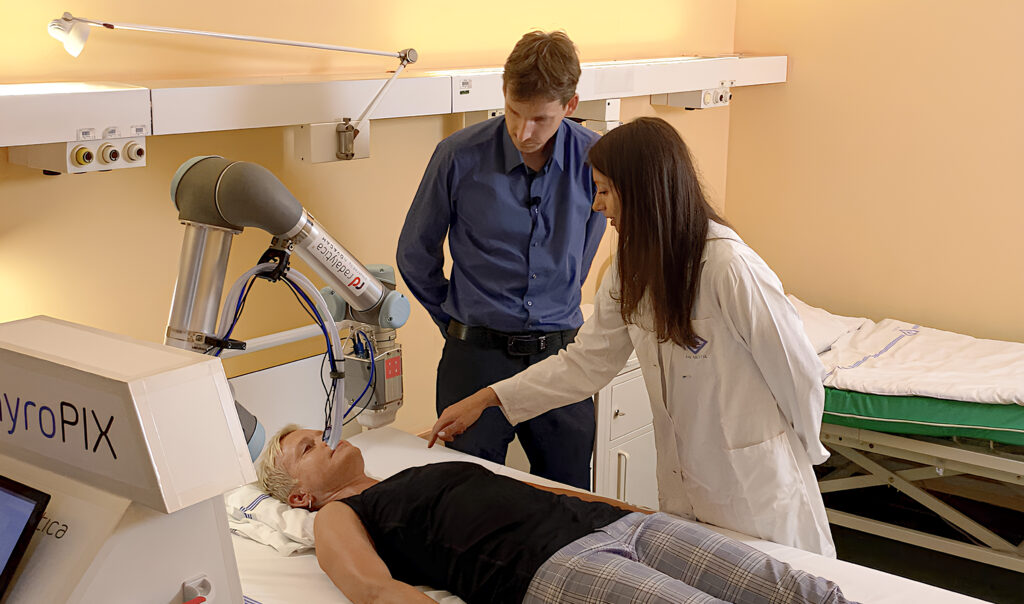
The newly developed robotic device could help to more accurately map the distribution of radioactive iodine in the detection and treatment of thyroid tumors. Thanks to the groundbreaking miniaturized gamma camera, capable of determining the direction of incoming radiation, it precisely locates where and how the radiopharmaceutical acts. The prototype, called ThyroPIX, was developed in as part of the project of the same name financed by the Technology Agency of the Czech Republic.
Doctors worldwide diagnose approximately 300,000 new cases of thyroid cancer every year. One common part of the treatment is radioiodine therapy, which is usually performed after surgical removal of the tumor. Even after surgery, there are usually tiny remnants of tumor tissue left in the patient’s throat and these need to be removed to prevent the disease from returning. Patients therefore receive a radioactive isotope of iodine, which accumulates naturally in the thyroid gland and irradiates the affected area locally, thus eliminating the cancerous growth.
The aim of the Thyropix project was to develop a unique medical device that will improve the possibilities of monitoring the effect of radiopharmaceuticals and minimize their possible side effects. Members of the consortium, which was supported in this successful research by the Technology Agency of the Czech Republic, were the 1st Faculty of Medicine of Charles University, Motol University Hospital, the Czech Metrology Institute and innovative companies Radalytica and ADVACAM.
THE AIM IS TO OVERCOME THE PHYSICAL LIMITS OF EXISTING METHODS
Existing methods often cannot provide sufficient guidance for deciding on the most appropriate treatment strategy. “Physically, the devices commonly used today are not able to have such a resolution for iodine-131,” explains Tereza Kráčmerová, a clinical radiological physicist at the University Hospital in Motol.
“We see a few spots there, but with poor spatial resolution, we are not able to pinpoint their exact location,” she adds. In addition, an examination takes about 20 minutes.
ThyroPIX uses a robotic arm to move closer to the scanned area, capturing it more accurately and consistently across repeated examinations. At the heart of the device are particle cameras manufactured by ADVACAM. Thanks to a newly developed methodology for using the so-called Compton scattering, it can determine the direction and energy of each individual incoming particle of ionizing radiation. In this way, it is possible to obtain detailed information on the size and shape of thyroid residues, thus verifying the distribution of therapeutic activity in the patient’s body.
SOFTWARE CREATES A 3D IMAGE OF THE DISTRIBUTION OF RADIOACTIVE IODINE IN THE PATIENT’S BODY
The software that the scientists developed as part of the project is crucial for doctors – only in the computer does the data obtained turn into an image with visible remains of the tumor. The gamma camera sensor captures the charge scattering that occurs when a photon passes through two layers of the sensor with different properties.
ThyroPIX has been tested on a phantom model developed by the Czech Metrology Institute. They also created a complete computer simulation of the entire detection systém.
The camera was tested at the Center for Advanced Preclinical Imaging at the 1st Faculty of Medicine, Charles University. “The main advantage of ThyroPIX is that it offers standardization of examinations, a wide field of vision and higher sensitivity than other devices,” says Luděk Šefc, head of the center, adding: “The compactness and the associated mobility of the device are also great. Thanks to it, it is possible to examine a patient directly in bed.”
WHEN WILL THYROPIX REACH REAL PATIENTS?
However, there are still a few steps left to put the innovation into practice. The gamma camera head needs to be adjusted to get even closer to the thyroid gland. Further software improvements are planned so that the device can eventually undergo clinical trials directly on patients. The authors are also now actively seeking an industrial partner interested in helping bring the solution to market as a finished product.
This project is funded with state support from the Technology Agency of the Czech Republic and the Ministry of Industry and Trade of the Czech Republic under the TREND Program.