

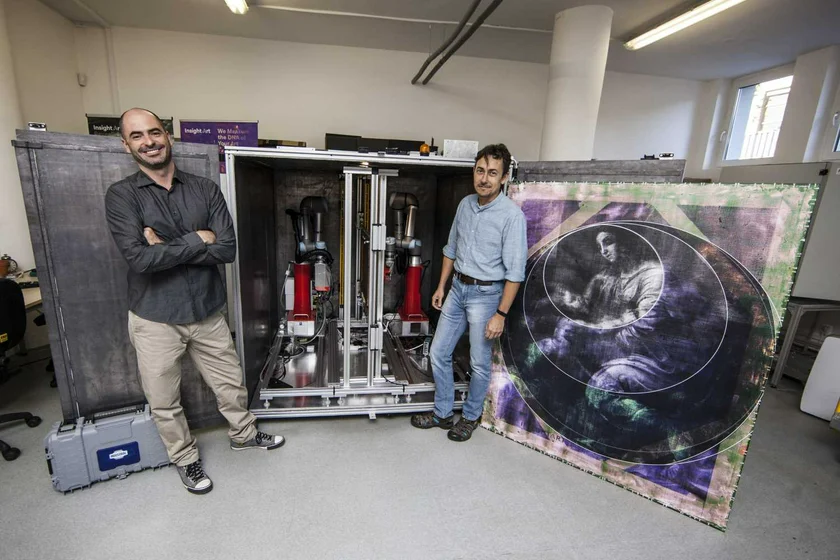
The same technology that measures radiation on the International Space Station revealed the structure of a Renaissance painting.
Radalytica a.s. is proud to have contributed to a groundbreaking project in which advanced space-derived technology helped authenticate a 500-year-old painting attributed to Raphael. Questions surrounding the authenticity of historic masterpieces remain a major issue in the art world, often involving differences worth millions. One such case concerned Madonna and Child, a work whose authorship had long been debated, with some experts attributing it to Raphael’s workshop or later copies.
The painting’s authenticity has now been confirmed through cutting-edge analysis conducted by InsightART. Central to this achievement is the RToo robotic scanner—an advanced X-ray system designed specifically for art investigation. The system incorporates a particle detector originally developed for space research at CERN and manufactured by Advacam.
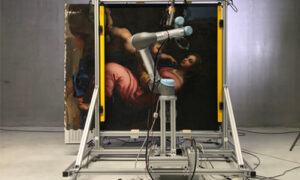
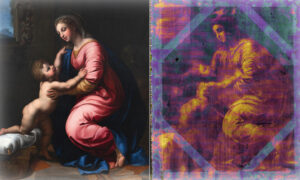
Radalytica a.s. played a key role by supplying the specialized robotic platform that enables highly precise, non-invasive scanning. Thanks to this platform, the RToo system produces spectral (color) X-ray images, revealing the elemental composition and internal structure of the painting in unprecedented detail—far beyond conventional black-and-white radiography.
The analysis confirmed that Madonna and Child was conceived with exceptional technical sophistication, from its underdrawing to final glazes. The findings clearly demonstrate that the painting was executed personally by Raphael, without the involvement of workshop assistants.
A remarkable historical journey
The significance of the discovery is further enhanced by the painting’s rich and complex history. The work, signed and dated “Raphael Urbinas Pingebat MDXVII, Roma,” was created in 1517 in Rome on commission from Pope Leo X as an altarpiece for the Sanctuary of the Holy House of Loreto. Shortly afterward, Raphael reused similar motifs in his Great Holy Family, which later became part of the collection of the Louvre Museum.
Madonna and Child remained in the Vatican until 1798, when it was taken to Paris during the Napoleonic occupation of Rome and became part of the collection of Napoleon Bonaparte. Following his fall, the painting was acquired by Louis XVIII, who later sold it to Charles Bosanquet, the first vice chancellor of Newcastle University.
The Bosanquet family retained the painting until 1928, when it returned to France via an art dealer. It was subsequently acquired by collector Ernst Beleuer, who brought it to Prague, where it was later owned by Otomar Švehla. Attempts were made to sell the work to both the Czechoslovak Presidential Office and Adolf Hitler, though unsuccessfully.
After changing hands several times, the painting eventually became part of a private Czech collection in the early 1990s. Since then, it has been the subject of extensive research and restoration led by Czech experts, culminating in a comprehensive restoration completed in 2019 under international supervision.
The final phase of research included a detailed re-evaluation of all previous analyses, focusing on the painting’s structure, underdrawing, and its relationship to Raphael’s other works. It was during this stage that InsightART and its advanced scanning technology played a decisive role.
The project also highlights the unique intersection of space technology and cultural heritage. Through this work, InsightART participated in the ESA Business Incubation Centre Prague, part of the European Space Agency network supporting innovative applications of space technologies.
Radalytica a.s. is honored to have contributed its expertise to a project that not only confirms the authenticity of a Renaissance masterpiece but also demonstrates the transformative potential of advanced robotics and space technologies in art research and conservation.

