


See beyond the surface. Discover what lies within.
What if you could uncover hidden defects, reveal invisible traces, or examine a priceless painting without touching or damaging it?
ERBIUM makes it possible.
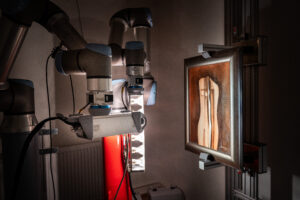
Developed by Radalytica in collaboration with the Criminalistics Institute of the Police of the Czech Republic, ERBIUM is an advanced robotic imaging system that brings multiple analytical technologies together in a single platform. Combining cutting-edge X-ray imaging, multispectral analysis, precision robotics, and intelligent data processing, ERBIUM offers a powerful new way to investigate objects of different sizes, shapes, and materials — without compromising their integrity. From forensic investigations and industrial accident analysis to art authentication and cultural heritage preservation, ERBIUM helps experts reveal details that conventional examination methods might miss.
One System. Multiple Technologies. Deeper Insights.
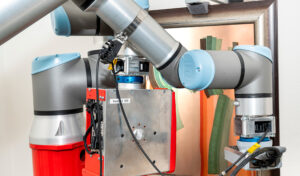
The real strength of ERBIUM lies in combining multiple complementary imaging and analytical techniques within a single robotic system. At its core are two highly flexible robotic arms. One can carry an X-ray source, while the other positions an advanced imaging detector. Its flexible robotic arms can reach complex geometries and hard-to-access areas, allowing experts to investigate objects that would otherwise be difficult to examine without disassembly or destructive sampling. Highly sensitive X-ray detectors provide detailed imaging, while complementary spectral and analytical techniques reveal information invisible to the human eye. Additional interchangeable modules expand the system’s capabilities to include elemental analysis, surface profiling, and imaging across different parts of the electromagnetic spectrum. This modular approach enables experts to investigate the same object from multiple perspectives, revealing information about its internal structure, chemical composition, surface properties, and hidden features.
And because all the measurements take place within one coordinated system, the results can be accurately aligned, overlaid, and analysed together.
Key advantages include:
- Non-destructive inspection: Examine valuable, delicate, or irreplaceable objects while preserving their integrity.
- Multimodal analysis: Combine structural, elemental, spectral, and surface information for a more comprehensive assessment.
- Flexible robotic positioning: Analyse objects with complex shapes and access areas that conventional systems struggle to reach.
- Precise data alignment: Overlay and compare results from different imaging methods in a unified coordinate system.
- Reduced handling risks: Minimise the movement of forensic evidence between separate instruments.
- Portable deployment: Disassemble, transport, and reassemble the system for measurements directly at the location of large or immovable objects.
Advanced Imaging Technologies Working Together
ERBIUM brings together a broad range of complementary technologies, each revealing a different layer of information.
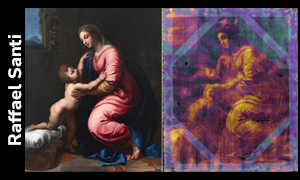


New Imaging Modalities Developed as Part of the Project
X-ray Diffraction (XRD) — Understanding Material Structure
X-ray diffraction provides information about the crystalline composition of materials, making it particularly valuable for identifying pigments and other crystalline substances. Building on Radalytica’s work within the European ComScat project, ERBIUM explores the integration of XRD into robotic scanning, including advanced data processing and visualisation for forensic applications. The aim is to move beyond conventional measurements of small extracted samples and enable spatial mapping of crystallographic composition directly across an examined object.
X-ray Fluorescence (XRF) — Mapping the Elements
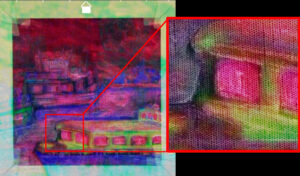
X-ray fluorescence reveals the elemental composition of an object and can visualise the distribution of elements across its surface. For art experts, this can help identify pigments, investigate material composition, and support authenticity assessments. In forensic applications, it provides valuable information about the materials present in an examined sample. Elemental maps can also be displayed in false colours, making differences in composition easier to recognise. When microscopic sampling is unavoidable, these results help experts choose the most informative location — reducing unnecessary damage.
Laser Profiling — Capturing Every Detail
Laser-based surface measurement adds a precise three-dimensional perspective to the analysis. While distance measurements help the robotic system navigate around the object, advanced laser profiling enables detailed mapping of surface geometry and texture, with precision in the tens of micrometres. This allows experts to document surface features, inspect irregularities, and combine geometric measurements with other imaging data.
VNIR Imaging — More Than Meets the Eye
Visible and near-infrared (VNIR) imaging captures spectral information that goes beyond conventional colour photography. By illuminating an object at different wavelengths and observing it from multiple angles, the robotic system can provide more detailed information about its surface and material properties. Flexible positioning also helps reduce unwanted reflections and shadows, improving the consistency of the acquired images.
SWIR Imaging — Revealing Hidden Layers
Short-wave infrared (SWIR) imaging extends the system’s spectral capabilities beyond the VNIR range. It is particularly useful for examining artworks, where it can reveal underdrawings and preparatory details hidden beneath visible paint layers. These features can offer valuable insight into an artist’s working process and help specialists investigate a painting’s history and authenticity.
UV Imaging — Making the Invisible Visible
Ultraviolet imaging reveals details that cannot be observed under normal lighting conditions. UV-induced fluorescence can highlight differences between materials, helping experts identify retouching, overpainting, restoration work, and other modifications. It can also provide information about varnish layers and support investigations in metallography and forensic material analysis.
Bringing the Laboratory to the Object
The robotic system can be disassembled, transported, reassembled, and calibrated on-site. Measurements collected in the field can then be processed and evaluated using workflows similar to those used in the laboratory. Instead of bringing the object to the scanner, ERBIUM brings advanced inspection capabilities to the object.
Innovation Recognised at the European Level
ERBIUM’s combination of advanced imaging technologies, flexible robotics, and portable design has earned international recognition. The project reached the finals of the Europol Excellence Awards in Innovation, achieving joint second place in the Technical Innovation category. This recognition highlights the potential of robotic multimodal imaging to advance forensic investigations and introduce new possibilities for non-destructive analysis.